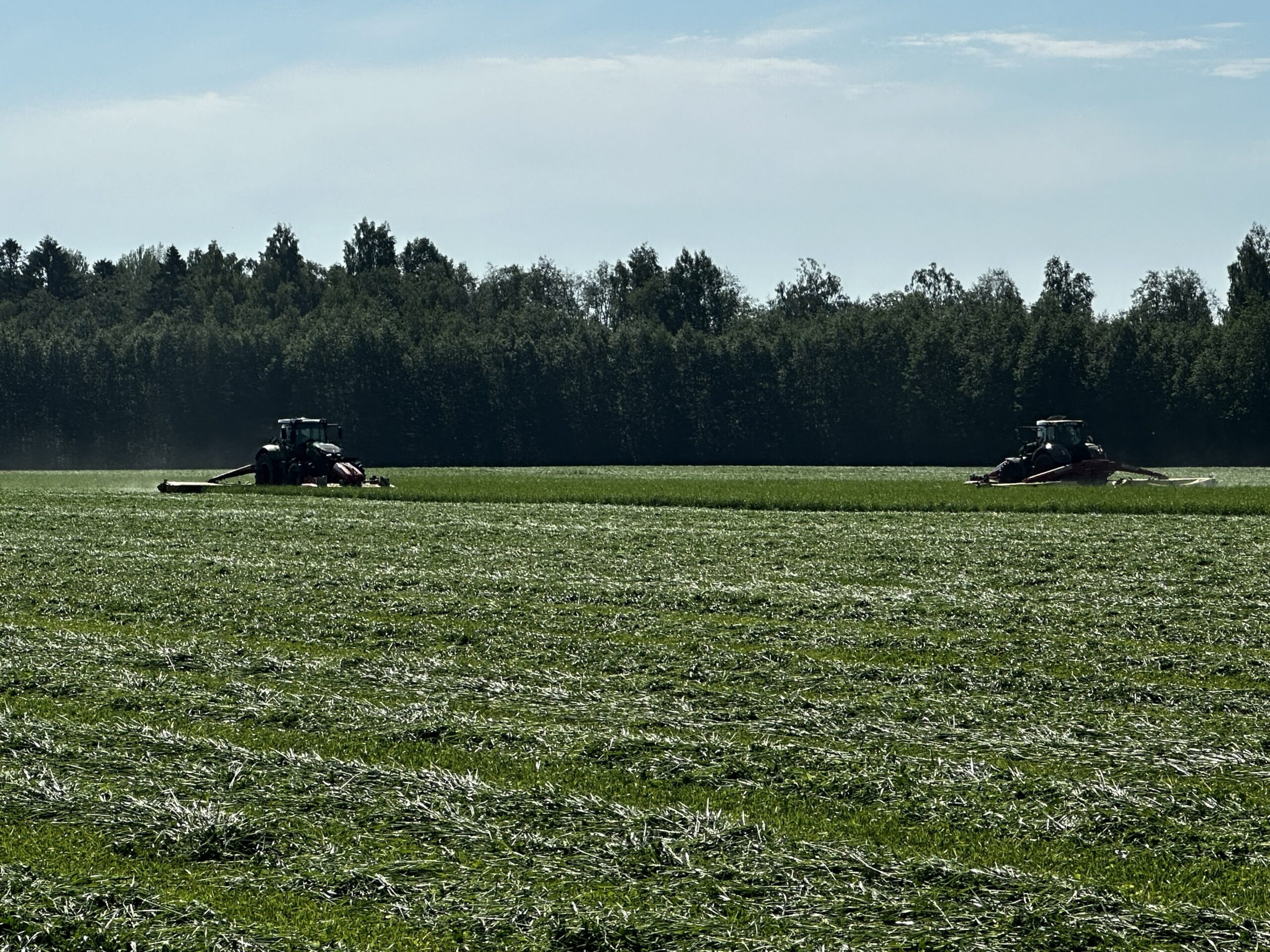
For dairy farmers, the spring of 2026 has been challenging. The raw milk purchase price dropped 13.9% in the first quarter, and the producer’s share of the retail milk price has fallen to just 20–39%, depending on the packaging. At the same time, the grass silage harvesting season has begun across Estonia. Right now, when milk prices are squeezing margins, the quality of home-grown forage is one area where the producer can decisively influence their own costs.
Making good silage doesn’t cost more than making bad silage. The difference lies in decisions, not in money.
What silage quality means for the bottom line
The economic impact of silage digestibility is direct and measurable. When digestibility is 55%, the missing energy must be compensated with concentrates — every 0.5 MJ drop in metabolisable energy significantly increases concentrate requirements in rations. At 69% digestibility, concentrate needs are substantially lower, and at higher digestibility the ration can be balanced with considerably less purchased feed. For a farm with 500 dairy cows, the difference between low and high digestibility silage can mean tens of thousands of euros per year in feed costs alone.
But it’s not just about feed costs. Low-digestibility silage means lower milk production and less revenue. Add metabolic problems — acidosis, ketosis, hoof issues — which drive up veterinary costs. In a low milk price environment, this is a double pressure no producer can afford.
In short: the difference between good and bad silage is not an agronomic question. It is a direct financial question that affects the profitability of dairy production every day, with every feeding.
2025 silage quality — numbers that make you think
The Estonian Agricultural Research Centre’s (METK) 2025 silage analysis summary shows there is significant room for improvement. 42% of analysed samples had dry matter below 28% — silage that is too wet, meaning worse fermentation and greater losses. Approximately 29% of grass silage samples had a pH above 4.5, indicating insufficient acidification. Dry matter digestibility ranged between 55–69%.
This 14-percentage-point difference in digestibility means hundreds of euros per hectare in concentrate cost differences in practice. Crude protein averaged 16.6%, but protein alone is not enough when energy content is low.
A question for every reader: what quality class was your silage from last year?
Spring 2026 — what to consider this season
The winter of 2025/2026 was generally favourable for grasses. A proper winter with snow cover — snow fell on cooled or frozen soil and plants overwintered well. Conditions varied by region, but the overall picture is good.
However, spring has been cool and dry. According to METK’s week 20 silage monitoring data, grass is still young — growth height only 20–26 cm and dry matter yield up to 2.0 t/ha. The positive news is that nutritional value is high: dry matter digestibility above 74% and metabolisable energy content above 11.5 MJ/kg.
The mowing decision doesn’t depend solely on the grass development stage. METK’s silage monitoring also tracks the effective temperature sum — grasses reach the optimal mowing stage at approximately 220–240 °C effective temperatures. But in practice, producers consider multiple factors simultaneously: weather forecasts, the farm’s workload and its duration, equipment availability, and logistics. If there are a thousand hectares to mow, it takes weeks — and you need to start early enough to complete the entire volume within the optimal window.
Practical steps that save money
Follow METK’s silage monitoring — it’s a tool that helps make better decisions. Data is updated weekly at metk.agri.ee/siloseire. Laboratory analysis of finished silage is an investment, not a cost. You need to know what you’re feeding your animals — only then can you formulate rations precisely and avoid overspending on concentrates.
The optimal dry matter content for ensiling is 30–33%. Correct timing of the first cut also creates conditions for stronger regrowth — this is ultimately a question of the entire year’s forage supply, not just one cut.
In times of low milk prices, the best investment you can make is quality home-grown forage. Every percentage point of digestibility you gain reduces your dependence on purchased feed and strengthens your farm’s economic resilience.
Sources
- METK 2026 week 20 silage monitoring
- METK: silage quality 2025 — lessons learned and how to do better in 2026
- PIKK: food price formation in Q1 2026
Want to assess the true cost of your grass silage and find where to save on feed costs? Let’s talk and map out the situation together.