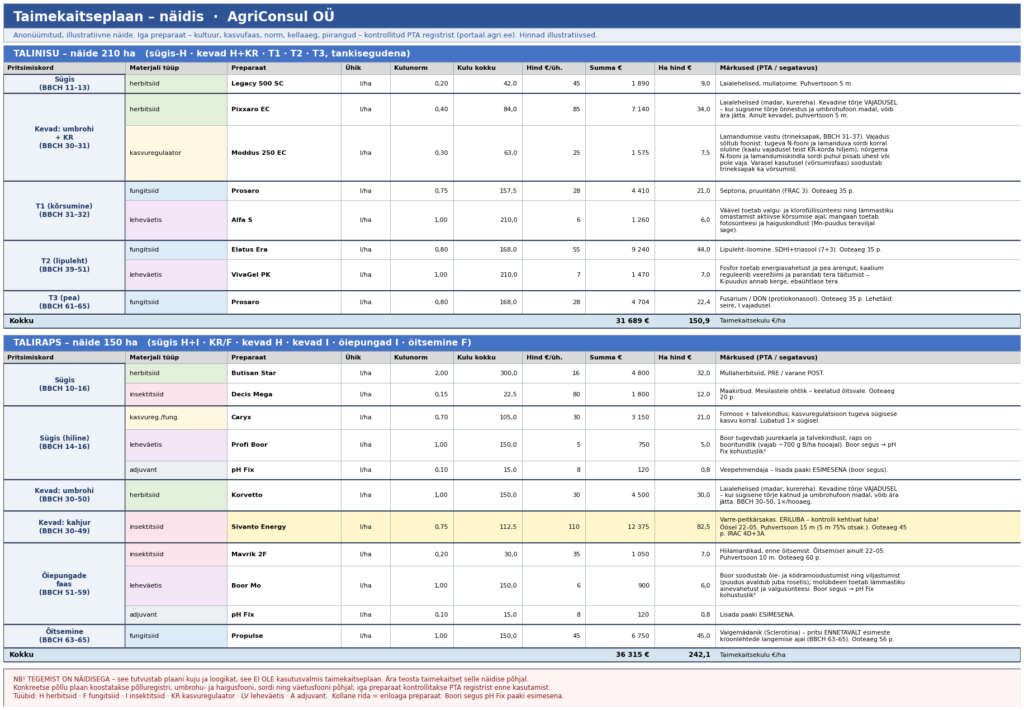
A concrete crop protection plan — crop by crop, stage by stage
Every product checked against the Estonian PTA register, every pass tied to a BBCH growth stage, every line driven by a formula. You get a plan you can actually take to the field — not a vague recommendation.
What you gain: the right product at the right time, fewer needless passes, confidence that the plan meets PTA requirements — and a clear protection cost per hectare.
Without a concrete plan, stock tends to pile up in the chemical store, and idle product is tied-up cash. The less that sits in the store, the more resource is free for where it is actually needed. The plan’s stock balance uses what you already have first and shows exactly what to buy.
What you get
A ready Excel crop protection plan built around your crops and hectares. It includes:
- spray passes by BBCH growth stage (autumn, T1, T2, T3) for each crop;
- tank mixes — which products go in one tank, the mixing order and compatibility warnings;
- active-ingredient rotation (HRAC / FRAC / IRAC) to prevent resistance;
- PTA-based restrictions on every line: buffer zone from water, time-of-day limits, pre-harvest interval, bee protection;
- a cost budget per crop (€/ha and €/t) with a stock balance.
How it works
- You give the input. You fill in a simple field register template: crops, varieties, hectares, previous crop, known weed and disease pressure, budget limit.
- We analyse. We check every product in the PTA register and follow the METK integrated pest management guidelines. We use your existing stock first, then plan purchases.
- You get the finished plan. An Excel file with four sheets: field register, crop protection plan, economic analysis and stock balance. All quantities and costs are formula-driven.
Sample output
An anonymised example from a ~410 ha farm (winter wheat, winter oilseed rape, winter barley, silage maize) is illustrative — it shows the shape of the plan, not a specific farm’s numbers.