A well-planned rotation is the foundation of crop production
The right crop sequence keeps soil fertility, lowers disease, pest and weed pressure — and only then is it also compliant on paper. We project crops for each field 5 years ahead, check the plan against CAP conditionality (GAEC 7) and the legume share requirement, compare gross margins and calculate your seed requirement from your seed analysis.
Your benefits:
- soil fertility is maintained — legumes and grasslands provide nitrogen and organic matter for the following crop;
- lower disease, pest and weed pressure — a proper break between the same crops interrupts disease cycles that are expensive to fix with chemistry afterwards;
- confidence that the rotation passes CAP checks — the 3-year cereal rule, rapeseed interval and legume share;
- you know exactly how much seed to procure and what it costs — the seeding rate comes from your seed analysis, not from the bag label.
What you get
A ready-to-use Excel rotation plan based on your fields and history. The plan includes:
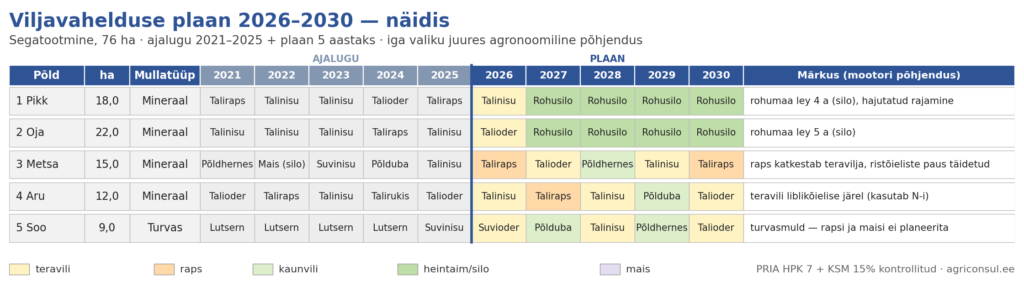
- a rotation matrix — fields × years (history + 5-year plan) with an agronomic reasoning for every choice;
- a compliance sheet with formulas — with a concrete fix suggestion for every violation;
- a gross margin comparison with and without subsidies, with editable prices;
- a seeding rate and seed requirement sheet — kg/ha from your thousand-kernel weight, germination and target plants per m², seed cost €/ha and total seed requirement in kilograms for the whole rotation;
- a feed balance for mixed farms — grassland and maize area calculated from livestock numbers.
Note: gross margin is not profit. It covers market revenue, subsidies and variable costs (seed, fertiliser, crop protection) — machinery, labour, land and overheads must still be paid out of it. The figure shows the ranking of crops and the direction of the rotation, not the final economic result.
How it works
- You fill in a simple template. Fields, areas, the last 5 years of crops, whether you apply for the eco-scheme, seed analysis data (thousand-kernel weight, germination) and livestock numbers if you keep animals.
- We design the rotation. Agronomically and economically, checked against CAP rules.
- You get the finished plan. An Excel file where you can move crops around yourself — compliance, gross margin and seed requirement recalculate automatically.
Sample output
The anonymised example is illustrative — it shows the shape of the plan, not any specific farm’s numbers.