Machinery audit: what to keep, replace, or buy as a service
An ageing tractor is not automatically the wrong call — the capital is paid off, the machine is cheap. The audit tells you with numbers which machine pays for itself and which one just sits there.
What you gain: you stop paying for machines that sit idle; every decision is backed by a number, and capital is freed up where it actually pays off.
What you get
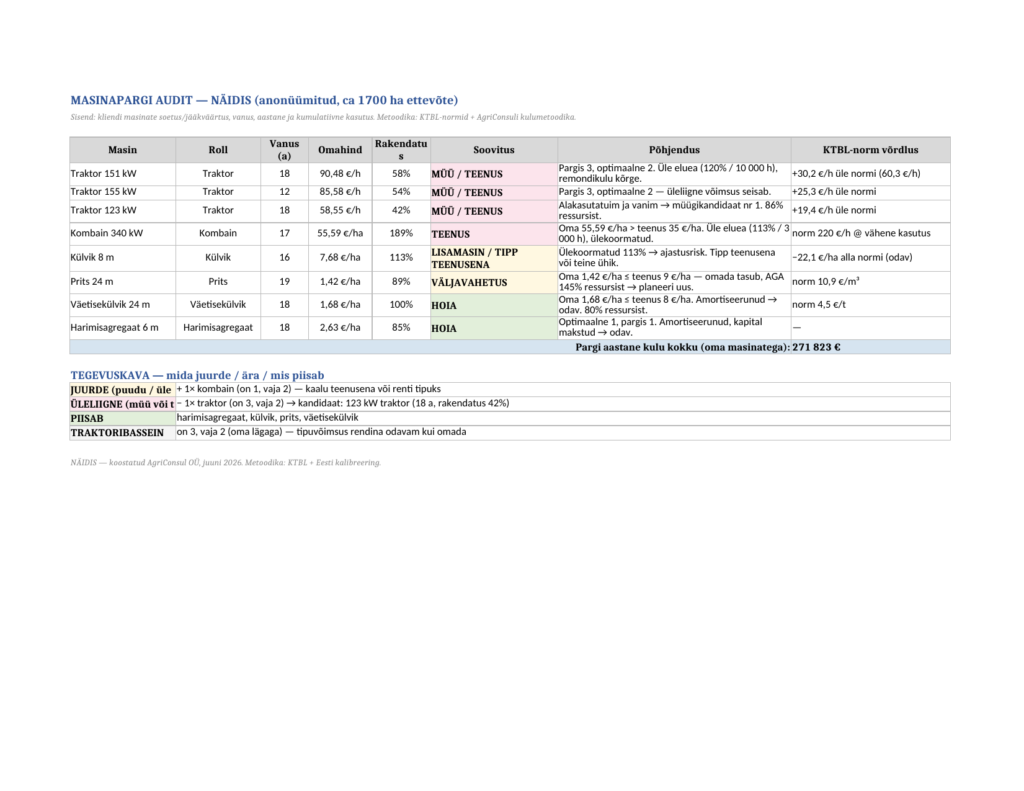
A report on each machine with a clear recommendation: keep / replace / sell / use as a service. Every recommendation is backed by a number:
- the machine’s own cost €/h or €/ha at your actual usage;
- utilisation in percent — whether the machine is under- or overloaded;
- the break-even point: when owning becomes more expensive than buying the same work as a service;
- a comparison with the KTBL reference-machine norm;
- an action plan: what to add, what is surplus, what is enough — with a concrete sale candidate.
How it works
- You give the input. You fill in a machinery template: model, age, purchase and residual value, annual and cumulative usage. You add your crops, hectares, planned yields, field operations and distances between fields.
- We analyse. We calculate each machine’s own cost using the AgriConsul cost methodology and KTBL norms, check the machine’s economic life and compare your fleet against the optimum for your scale.
- You get the finished report. A machine-by-machine recommendation, the fleet’s annual total cost and an action plan — what to add, what to drop, what is enough. All assumptions are visible.
The calculation gives a solid theoretical analysis. Alongside it comes the agronomist’s and crop-protection manager’s years of hands-on practice — together they make a decision that actually pays off.
Sample output
An anonymised example from a ~1700 ha farm with eight machines is illustrative — it shows the shape of the audit, not a specific farm’s numbers.