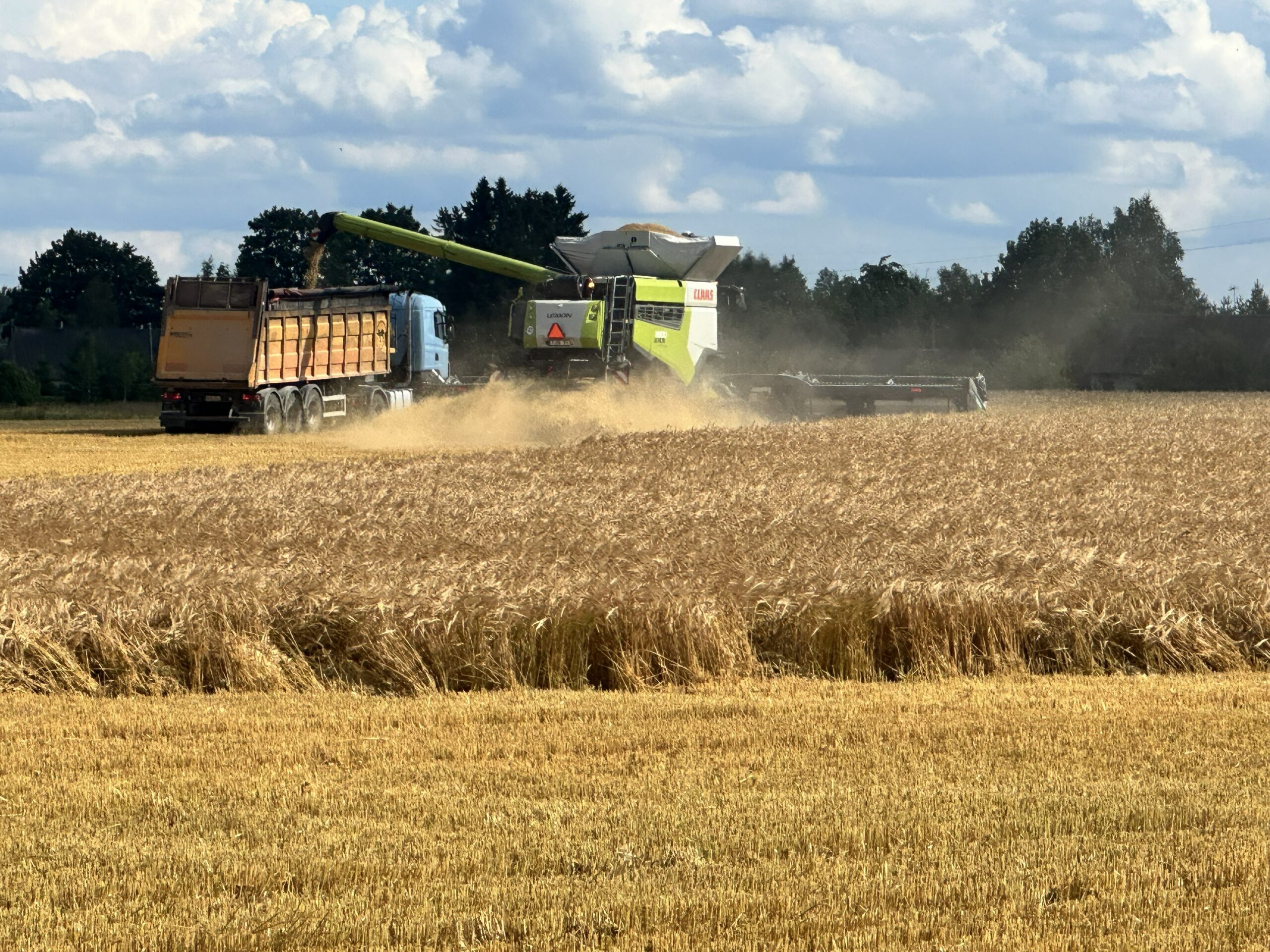
I recently wrote about choosing a grass silage harvesting method and recommended calculating machine costs upfront. The same applies to grain combines — only the numbers are bigger and the decision ties up capital for years. I’m looking at this from two perspectives simultaneously — as a crop manager who knows the cost of the harvest window, and as a financial manager who knows the cost of capital. The methodology comes from the German KTBL machine cost accounting system, with price levels kept at Estonian levels.
In Estonia, approximately 351,000 hectares of grain are harvested for grain (Statistics Estonia). The average producer manages a small fraction of this, meaning for most farms, an own combine would stand idle for most of the year. The substantive question only arises at larger acreages.
A combine can be used in three ways — purchase, seasonal rental, or contract harvesting. The harvest window is short and the weather dictates when the grain needs to be combined. Owning a machine gives you that timing control, but requires a long-term lease or loan commitment. Rental gives the same timing without such a commitment. Contract harvesting is often the cheapest in absolute costs, but you depend on the contractor’s queue — and that queue rarely arrives exactly when your field is ready.
Why a combine is so expensive per hectare
A combine’s cost consists of six components: depreciation, capital cost (interest), insurance, storage, repairs, and fuel. According to KTBL calculations, approximately two-thirds of these are fixed costs — they run regardless of whether the machine is working or standing idle. This is exactly what explains why low annual utilisation drives up the cost per hectare: a large fixed cost is divided over fewer hectares.
KTBL methodology corrects three common mistakes:
- A combine doesn’t depreciate to zero — after its useful life it retains ~20–30% of its value. This residual value must be factored in, otherwise you overestimate depreciation.
- A combine has a dual useful life: it reaches the end either after ~15 years or ~3,500 working hours, whichever comes first. At high annual workloads, the machine wears through hours faster — at 1,500 ha/year, the useful life is reached in about 7 years.
- Repairs consume approximately one-fifth to one-quarter of the purchase price over the lifetime. This is no small side cost.
Using Estonian prices, we take a new large-class combine costing ~€500,000, with a productivity of ~3 ha/h and fuel consumption of ~17 l/ha (approximately €15/ha with marked diesel). The harvest cost per hectare in METK gross margin calculations is in the range of €90/ha, and METK confirms that machinery costs have been trending upward in recent years.
Own work cost and payback period
Cost of owning a combine (KTBL methodology, Estonian price levels) and payback period — i.e. how many years it takes to recover the net cost compared to contract harvesting at ~€90/ha:
| Annual harvest area | Own cost €/ha | Payback period |
|---|---|---|
| 600 ha | ~103 | ~22 years (exceeds machine lifespan — not viable) |
| 800 ha | ~90 | ~13 years (at the limit of useful life) |
| 1,000 ha | ~83 | ~9 years |
| 1,300 ha | ~77 | ~6 years |
| 1,500 ha | ~74 | ~5 years |
The break-even point is around 800 ha, where the cost of owning equals contract harvesting. An own machine starts paying off within a reasonable timeframe only from ~1,000 hectares upwards.
Rental and the logic of capital
Many believe that money invested in your own machine doesn’t disappear but remains in the form of the machine. From a financial manager’s perspective, this is not the case. Most of that money is consumed: depreciation — the difference between purchase price and residual value — is genuinely lost money, not savings. Only one-fifth to one-third of the machine’s value ultimately remains, and on top of that you carry the interest on tied-up capital and repair costs.
Seasonal rental of a combine in Estonia costs €45,000–60,000 (e.g. Nova Rent), which is roughly the same as the annual cost of an own machine. The difference lies in the obligation. To purchase an own machine, the farmer typically takes a lease or loan — a down payment, a multi-year payment schedule and interest — and bears the residual value and repair risk themselves. Rental requires no down payment or long-term financial commitment, and the residual value and repair risks stay with the rental company. This keeps borrowing capacity free for other investments — land, inputs, other machinery — and provides the same timeliness. Thus an own machine is not inherently more advantageous than rental. An own machine only pays off when high annual utilisation drives the cost per hectare clearly below the rental price.
The break-even point depends on machine price
The break-even point depends not only on hectares but primarily on the price of the machine. With a new combine costing approximately €500,000, the threshold falls around 800–1,000 hectares. Here, however, it’s worth thinking more broadly: you don’t always have to buy a brand-new machine. A few-year-old, well-maintained used combine costs significantly less but does the same work — and a lower purchase price also lowers the break-even point, often by several hundred hectares. Too cheap a machine, however, usually turns out to be a money pit, where repair and downtime risk quickly eats up the savings. The sensible path is somewhere in between: new enough to be reliable, but not at the price of a brand-new machine.
Decision
- below ~500 ha: rental or contract harvesting is almost always cheaper;
- ~800–1,000 ha with a new machine (less with a used machine): an own combine starts to pay off;
- a short harvest window and high weather risk may justify an own machine even at lower acreages — in one wet autumn, yield and drying losses can exceed the entire machine cost difference.
An own combine is not an end in itself, nor money that stays with you — most of it goes in depreciation and repairs. The decision depends on two cold numbers: how many hectares you harvest each year and how expensive the machine is. Run the calculation before the purchase, not after, and write down the assumptions: purchase price, annual harvest area, interest rate, useful life (years and hours), and residual value.
Considering whether your machinery fleet needs rethinking? We’ll work through together whether ownership, rental, or contract harvesting is most advantageous for your harvest area.
Related service: Wondering whether owning your combine or machine pays off? The machinery audit tells you with numbers what to keep, replace or buy as a service — Machinery audit →